Previously: I noticed an interesting passage in a book about upper-class Regency society, by Venetia Murray. Upon further investigation I was able to firmly establish that there was a high likelihood that Venetia Murray had misinterpreted a letter describing Dorothea von Lieven’s attire at a society even in February 1813.
Princess Lieven (then Countess von Lieven), was described in a first-hand account to have been attired in either a fancy-dress costume or historicised fashionable dress. One key to narrowing down which of these it might have been, and ultimately gaining a more in-depth idea of this entire episode, is an understanding of the event which she was attending. The Morning Post is often a reliable source of information on society events during this period.
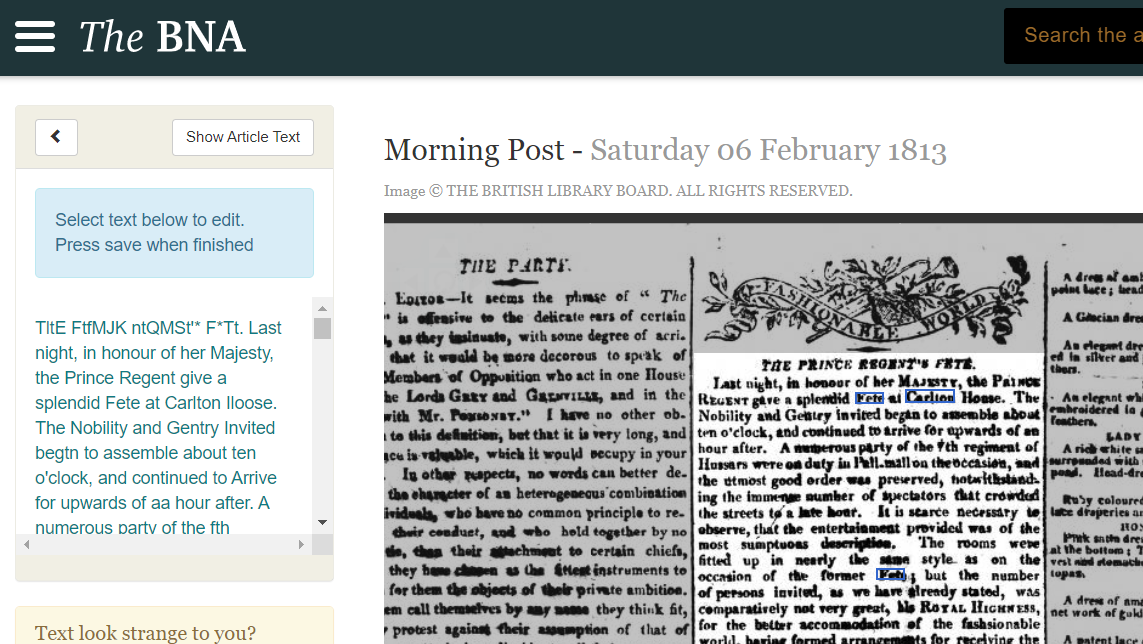
With a fairly clear date from the letter, identified in the last blog post, it didn’t take long to find an article about the event. Described as a “Fete”, it was a ball organised by the Prince of Wales (later George IV) in honour of Queen Charlotte.1
Denoting the entertainment as a “Fete” could mean that it was something in the order of a fancy ball. The Prince of Wales also held a “Fete” in July 1819, and it was also reported as a “Grand Fancy Ball”.2
Additionally, The Morning Post published descriptions of the “Dresses of the Ladies at the Fete”; and sure enough, printed in black and white was a description of “Her Excellency the Countess of Lieven”:
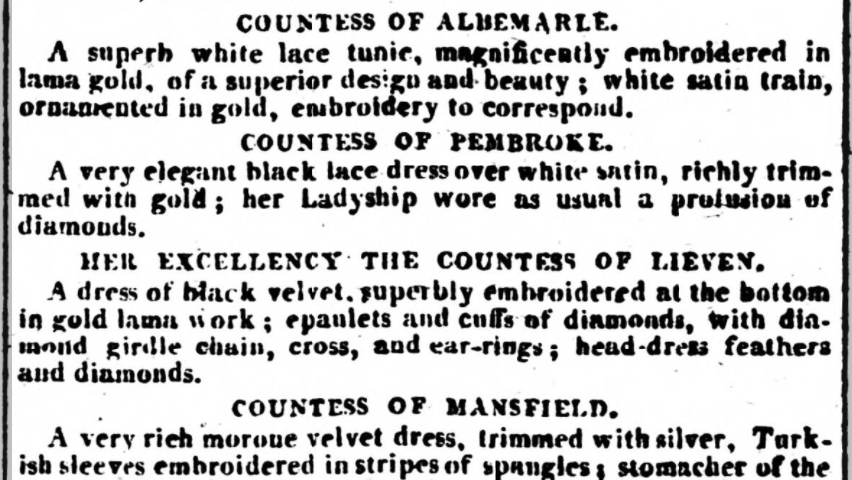
A dress of black velvet, superbly embroidered at the bottom in gold lama work; epaulets and cuffs of diamonds, with diamond girdle chain, cross, and ear-rings; head-dress feathers and diamonds.
‘The Prince Regent’s Fete’, The Morning Post, 6 February 1813, British Newspaper Archive.
From this description, there is certainly no suggestion that the Dorothea von Lieven dress was out-of-the-ordinary. However, the description corroborates that of Lady Elizabeth Feilding, and has one very subtle indication that the dress is historicised or of the fanciful variety: “diamond girdle chain”.3 A girdle chain is often seen in historicised fashion and fancy-dress fashion plates of the Regency period. They were often based on fifteenth and sixteenth century style girdles, or women’s belts.
Other descriptions of dress from the event suggested that it was most probably a fancy-dress entertainment. While the very high ranking ladies such as Princess Charlotte of Wales, Princess Mary and Princess Sophia of Gloucester, may have opted for courtly elegance other women chose more fanciful attire.
The variety does not conform to a theme, it is eclectic and varied, typical of the Regency era costume balls:4
- The Countess of Besborough wore “a truly magnificent stomacher”, typical of historicised design in the period.
- The Countess of Albemarle “a superb white lace tunic” a fancy-dress inspired by the classical period.
- The Countess of Mansfield had “Turkish sleeves embroidered in stripes of spangles, a stomacher of the same”.
- A Miss Wood, attended wearing “a patent net dress, richly embroidered all over in pearls, with a beautiful border at the bottom of grapes and vine leaves.”
- Mrs. Osbourne had an “Indian” border.
- Mrs. Boehm “a Spanish dress, combining novelty and elegance”.
It does, therefore, seem safe to say that Dorothea von Lieven was conforming to the expectations of the Prince Regent’s ball when she dressed in historicised style, reminiscent of Elizabeth I or Mary Queen of Scots.
Yet, some important questions still remain. What might this dress have looked like? What imagery came to mind when Regency women thought of the past? How did that visual culture translate into sartorial splendour?
To Be Continued…
References:
- ‘The Prince Regent’s Fete’, The Morning Post, 6 February 1813, British Newspaper Archive.
2. ‘Fashions for August, 1819’, La Belle Assemblée, or, Bell’s Court and Fashionable Magazine Addressed Particularly to the Ladies, 1 August 1819, Gale Primary Sources. ; ‘The Regent’s Grand Fancy Ball’, The Morning Post, 19 July 1819, British Newspaper Archive.
3. Mary Frampton, The Journal of Mary Frampton: From the Year 1779, Until the Year 1846. Including Various Interesting and Curious Letters, Anecdotes, &c., Relating to Events Which Occurred During That Period (S. Low, Marston, Searle, & Rivington, 1885), 159.; ‘The Prince Regent’s Fete’, The Morning Post, 6 February 1813, British Newspaper Archive.
4. ‘The Prince Regent’s Fete’, The Morning Post, 6 February 1813, British Newspaper Archive.


Leave a Reply