Research Outputs:
Journal Articles:
- Hodge, Sarah J. “Queen Victoria’s Banarasi Brocade: A Transcultural Approach to Royal Fashion,” Fashion Theory 29, no. 1 (2025): 51-73. DOI: 10.1080/1362704X.2024.2435726
Book Reviews:
- Hodge, Sarah. “Review: Judith Anderson: Australian Star, First Lady of the American Stage by Desley Deacon,” ANU Historical Journal II (2022). DOI: 10.22459/ANUHJII.2022
Current Research Projects:
Sartorial Entanglement: A new interpretation of “Truth to Nature” in William Holman Hunt’s The Awakening Conscience, 1853

Colour and materiality play a vital role in many of William Holman Hunt’s (1827-1910) artworks. This research uses a dress and materiality lens to analyse the deeper implications of “truth to nature” within The Awakening Conscience (1853). Objects are central to the reading of this artwork, but in terms of “truth to nature” there are still many sartorial elements that have been underrepresented in the scholarly literature. This painting represents the idea of “truth to nature” in both its symbolism and materiality. Scholars and art critics have long debated the moral quandary within the composition which depicts a so-called “fallen woman,” and if Hunt’s composition offers hints towards her redemption. Bringing a fresh sartorial lens to analysis of this work reveals a new, more nuanced reading, drawing on the hints provided by the woman’s dress as to the current and future status of her social standing. This research considers how a close analysis of this woman’s attire from necktie to petticoat and leather shoe to shawl, unearths a more complex and detailed picture of Hunt’s portrayal of this young woman. It also brings new dimension to the idea of “truth to nature,” considering, for example, that the same madder pigment may have been used for Hunt’s red paint and also the dying of the red shawl. The young woman’s self-fashioning is likely designed to represent a mixture objects gifted by her male companion, and those selected herself. Allowing greater significance to these garments permits new readings of this well-researched painting.
Past Research Projects:
Fashioning women’s agency in Nineteenth-Century Britain: the wearers and makers of historicised fancy-dress, 1796-1856
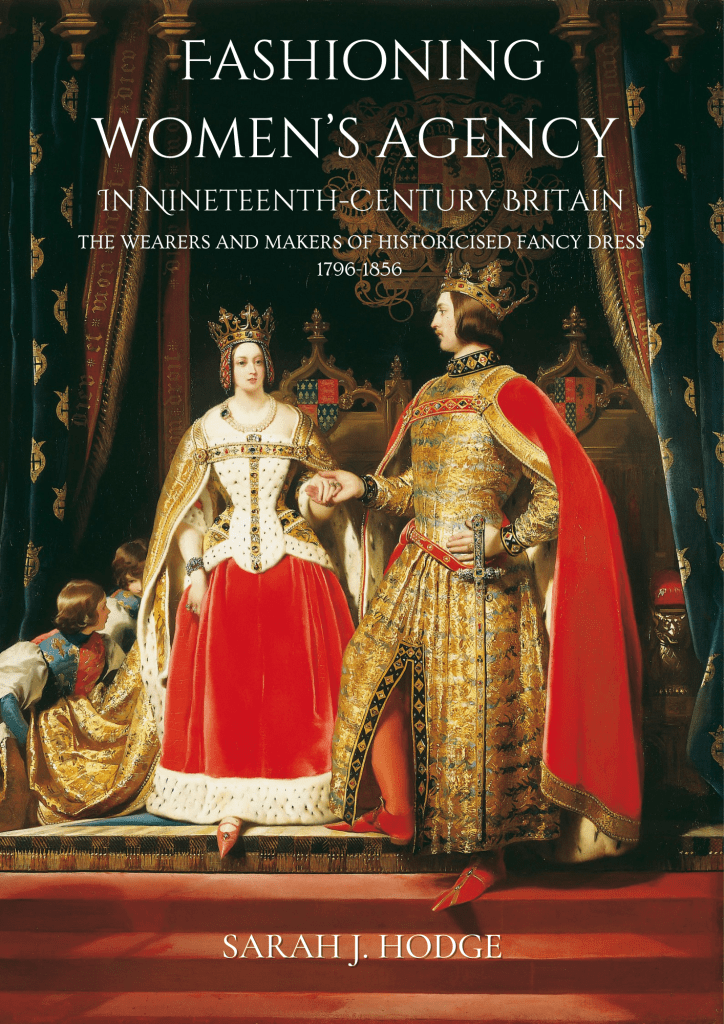
In the early nineteenth century, royal and aristocratic women used fancy-dress costume to fashion political and cultural agency in British society. This study, centred around Queen Victoria’s costume balls held in 1842, 1845 and 1851, situates those events within the world of elite fashion. By uncovering references to historical figures that inspired guests at those balls, I argue that their costumes were carefully constructed forms of self-expression. Fancy dress was an intricate, luxury commodity, but costumes were often only worn for one night. By contrast, the craftspeople who transformed the costumes from raw material to finished garment, spent weeks working with the materials. Drawing together a range of approaches and literatures, from cultural history to material culture studies, the principal innovation of this study is to recover forgotten histories of the women who wore and made historicised fancy dress to reveal their vital contribution to the vogue for historicism in Britain during the nineteenth century.
Undressing the Self: A History of Fancy-Dress Balls in Britain’s Long-Nineteenth Century

Britain’s long nineteenth century witnessed the emergence and development of both fancy-dress balls and the modern sense of self. First appearing in Dublin around 1770s, fancy-dress balls entertained the people of Britain beyond the close of the long nineteenth century. However, by the 1890s its popularity began to wane. This thesis uses the study of fancy-dress balls and their costumes to unwrap the complex layers of the making and evolution of the modern self. Combining cultural and dress history, it uses fancy-dress balls as a lens through which to explore broader social phenomena. The thesis establishes the links between fancy-dress and the masquerade balls from which they diverged in the late eighteenth century and illuminates the ties which bind masquerade to the ancien régime of identity and fancy-dress to the modern self. It also explores the origins of fancy-dress and argues that the history of fancy-dress demonstrates that the making of the modern self was a more complex process than the traditional distinction of an ancien régime and modern self suggests. Despite its appearance as a merely decorative entertainment, fancy-dress balls provide a unique insight into the invention of the modern identity.
 Sarah J. Hodge