The lack of referencing in older secondary historical writings has always both irritated and inspired me. It can be frustrating when rather grand assertions are made, with no hint of a reference to follow it up. On the other hand, often I enjoy the challenge of chasing down the trail of more specific examples mentioned by writers, but not accompanied with a helpful reference.
Of course, sometimes it can be a time consuming, and ultimately fruitless task, but this series of blog posts are about an instance when my sleuthing soon paid off and led to interesting results.
This week, I was in search of examples of upper-class women dressing as Mary Queen of Scots to attend costume balls during the first three decades of the nineteenth century. Skimming through various works on upper-class society in Regency England, my eyes stumbled across an interesting example in Venetia Murray’s 1999, An Elegant Madness: High Society in Regency England.
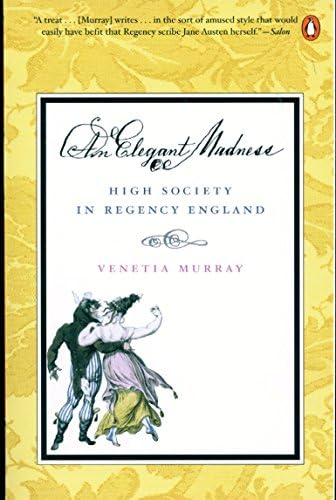
Murray was discussing Princess Lieven, the wife of the Russian Ambassador and the first foreign woman to be elected a patroness of Almack’s.
A handsome rather than beautiful woman, Princess Lieven was not averse to being the centre of attention herself. She was liable to appear at parties in what amounted to fancy dress. At one Court function, she turned up wearing a high-necked black velvet robe, with a huge Elizabethan ruff; her only ornaments hung on her back. At a time when the prevailing fashions for women’s hair was a cloud of curls and ringlets, Princess Lieven dressed hers flat on her head, thus completing the image of Mary Queen of Scots. A fellow guest described her as looking ‘exactly like something walked out of its frame in an old picture gallery’. All this affection and bitchiness made Princess Lieven thoroughly unpopular.
Venetia Murray, An Elegant Madness: High Society in Regency England (New York: Viking, 1999), 56.
Bit harsh… but let’s examine the evidence.
I felt quite certain that there was every chance that this dress was actually fancy-dress, or perhaps historicised fashionable dress. The early years of the 1800s saw fancy balls rise in popularity to replace the masquerade, a much more eighteenth-century costumed entertainment. A new generation required a new costumed event and parallel to this rise, was the popularity of women’s fashionable attire inspired by early modern European history. Women would dress in styles evoking Mary Queen of Scots, Elizabeth I, Van Dyck and others.
With this context in mind, I wanted to find out more about the primary source underpinning Murray’s strong comment that “she was liable to appear at parties in what amounted to fancy dress”.1 There was no footnote for the direct quotation appearing further down the page which appeared to come from a first-hand account, or the other information for that matter. I did check the references for that chapter regardless, but there were no titles that seemed to be the likely candidates for the quote upon which much of the passage was based. Therefore, I decided to begin by just typing the quotation into Google Books and see if there were any promising results…
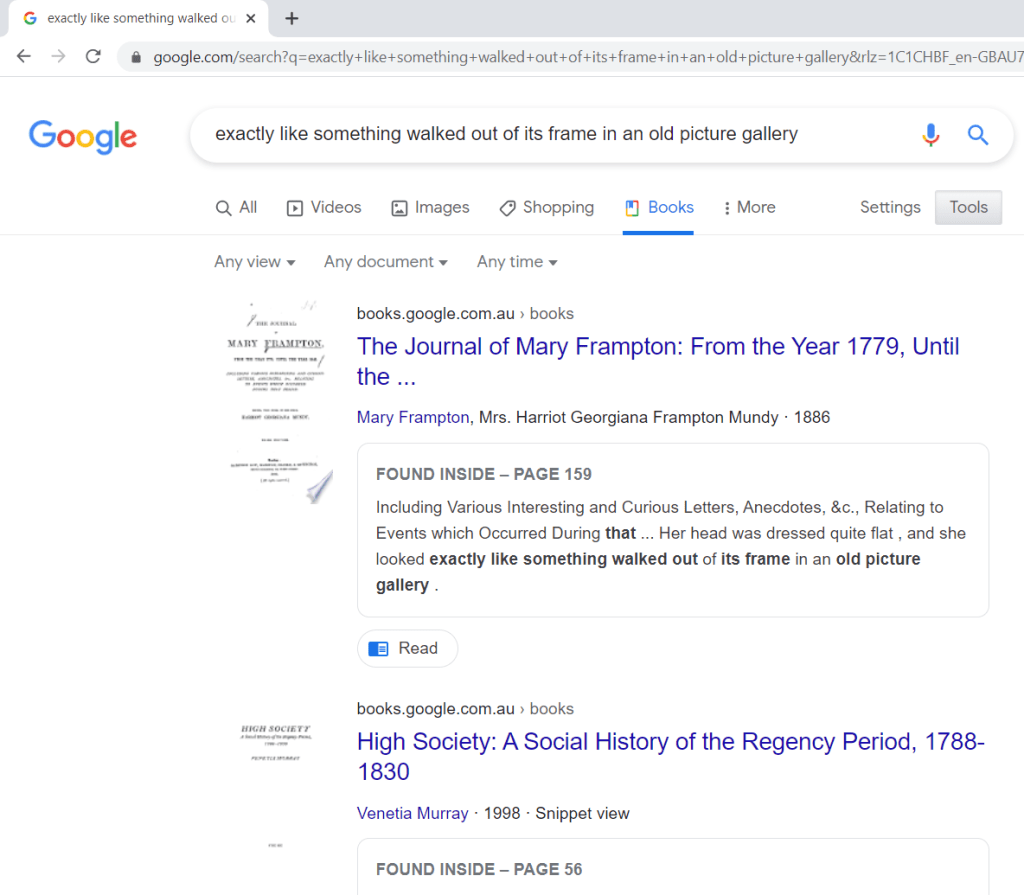
SUCCESS!
It’s from a letter, printed in a nineteenth century publication: “The Journal of Mary Frampton, from the Year 1779, Until the Year 1846. Including various interesting and curious letters, anecdotes, &c., relating to events which occurred during that period”.
The letter from which the direct quote was taken provided much more contextual information into this possible Mary Stuart dress and whether it was a bizarre or strange dress for the occasion as the secondary work suggested.
Lady Elizabeth Feilding reported in February 1813 that she had attended an event at Carlton House and it was there that she saw the Russian Ambassadress:
At last you arrived at the ballroom, where sat the Queen at the upper end, with the Princess de Condé on her right hand, and the Russian Ambassadress on her left. This last was a most singular figure; she was in black velvet up to her chin, with a huge ruff like Queen Elizabeth, or rather more like Mary Queen of Scots, for she is very handsome. She had no ornaments whatever but a long chain of very large diamonds, and a picture that hung on her back. Her head was dressed quite flat, and looked exactly like something walked out of its frame in an old picture gallery.
Mary Frampton, The Journal of Mary Frampton: From the Year 1779, Until the Year 1846. Including Various Interesting and Curious Letters, Anecdotes, &c., Relating to Events Which Occurred During That Period (S. Low, Marston, Searle, & Rivington, 1885), 159.
This longer first-hand account suggests that the then Countess von Lieven was dressed in historicised fashionable dress, or fancy-dress. It would depend on the occasion. The identification as Mary Queen of Scots is not entirely certain, as Lady Elizabeth Feilding describes the ruff as “like Queen Elizabeth, or rather more like Mary Queen of Scots”, but this is reflective of the trends in fashionable and fancy-dress during the Regency period.2
Far from dressing differently in a negative way, Dorothea von Lieven’s dress and manners drew the favour and attentions of Her Majesty, Queen Charlotte. The next stage on my mission to understand this dress is to learn more about the event which was being held at the end of winter in 1813. I am hopeful that I might find more about that in the newspapers.
To Be Continued….
References
- Venetia Murray, An Elegant Madness: High Society in Regency England (New York: Viking, 1999), 56.
- Mary Frampton, The Journal of Mary Frampton: From the Year 1779, Until the Year 1846. Including Various Interesting and Curious Letters, Anecdotes, &c., Relating to Events Which Occurred During That Period (S. Low, Marston, Searle, & Rivington, 1885), 159.

 Sarah J. Hodge
Leave a comment